Obituaries can provide much information about the men and women behind the making of agricultural implements and machines, their businesses as well as their wider contributions to the communities in which they lived. We also get to read about their characters and sometimes their temperaments.
We have looked through a number of obituaries from some of the Scottish agricultural implement and machine makers from 1935. That year saw the passing of a number of makers. Some of them will be well-known to modern readers, others less so.
The first is David Davidson, Montrose, in the Brechin advertiser of 26 March 1935:
“Death of veteran agricultural engineer
The death occurred last Monday in the County Hospital, Brechin, of Mr David Davidson, who for many years had been associated with the engineering industry of Montrose. He was 87 years of age and for more than half-a-century had taken an active part in the installation of machinery in industrial concerns and farming establishments in the district.
The son of a farmer, Mr Charles Davidson, who was at one time tenant of Smallbank, near Marykirk, the deceased was born at Strachan, on Deeside. Eighty-six years ago, when Mr Davidson was born, the engineering business in Montrose was a flourishing one, and there were opportunities for the youth of the district to get a first-rate training. Mr Davidson served his time in the Links Foundry in Russell Street, and was employed for a time at Newcastle, but on leaving there he returned to Montrose, and had worked in this district continuously up to the date of his retirement. Threshing mills and farm machinery were a speciality of Mr Davidson’s, and until the introduction of oil engines there were few farms in the district which did not bear the mark of his handicraft.
Mr Davidson was a keen sportsmen and an expert shot. He did not retire until 73 years of age, when he came to Brechin up spend the remaining years of his life. He had a family of 14, one of whom, Sergeant-Major Davidson, of the 2nd Black Watch, was killed during the war. He is survived by six sons and five daughters, two of the former of whom reside in Montrose.”
A well-known Aberdeen name was Alfred Bisset of Bisset and Co., engineers, West North Street. The Aberdeen press and journal of 14 March 1935 noted:
“Former agricultural engineer
Death of Mr Alfred Bisset, Aberdeen
A well-known personality among farmers in the north-east of Scotland, Mr Alfred Bisset, engineer, died yesterday at his residence, 4 Park Road, Aberdeen.
Born at Aberdeen sixty-five years ago, Mr Bisset served his apprenticeship with his father, who was proprietor of the firm of Bisset and Co., engineers, West North Street. He succeeded to the business son the death of his father, and carried it on until some twelve years ago, when he retired.
The firm specialised in agricultural machinery, and Mr Bisset was widely known by farmers throughout the district.
Outside his business Mr Bisset had few interests except Freemasonry. He was a member of the Old Aberdeen Lodge.
Mr Bisset had been ailing for about a year, but had been confined to bed for only three weeks.
Predeceased by his wife thirteen years ago, he is survived by three sons and two daughters.”
A well-known Glasgow name was Robert Wallace, a director of Messrs John Wallace & Sons, agricultural engineers. Dennistoun, Glasgow, noted by The Scotsman on 3 July 1935:
“Late Mr Robert Wallace
The death has occurred of Mr Robert Wallace, a director of Messrs John Wallace & Sons, agricultural engineers. Dennistoun, Glasgow. The business was established over 70 years ago. Mr Wallace travelled for many years on behalf of the firm, and regularly visited the agricultural markets of Fife, Perthshire, and the Lothians. An authority on agricultural matters, his advice was much in demand. He was the youngest of four brothers.”
Accounts of local agricultural shows provide a snapshot of who was making and selling implements in a local area. They can provide evidence in the absence of other sources of evidence being available. This is especially important for geographical areas that are away from the main implement and making businesses.
An account of the Caithness Show from the John O’Groat journal of 4 August 1911 shows that there was a good display of implements and machines from a range of businesses. They included manufactures from local makers as well as leading makers throughout Scotland and further afield. They sold ones that they thought could be useful to the local farmers and crofters and were suited to the needs of the local district. For example, Ben Clyne had “the new Osborne binder, a machine that appears very suitable for the crofter”. There were also other implements and machines seen to be suitable for the smaller farmers and crofters. The author of the account also noted the practicality and economy of some of them.
There were implements and machines from a number of leading makers in Scotland and further afield. They included: George Sellar and Son, Huntly, J. Bisset & Sons, Blairgowrie, Alexander Jack & Sons, Maybole, Melotte Separator Sales Co. (1931) Ltd, Campbell Gas Engine Co, Kingston, Halifax, and E. H. Bentall and Co, Heybridge.
The following is the account of the implements at the Caithness Show:
“Implements
There was a great show of agricultural implements on the ground. Messrs W. & A. Geddes, Wick, had a fine display of binders, back delivery reapers, corn winnowing machines, manure distributors, churns, and cream separators, samples of poultry food, sheep dip in paste and liquid, oil cake crusher, and a Sellar’s plough.
Mr Ben Clyne was on the ground with a specimen of the new Osborne binder, a machine that appears very suitable for the crofter. He also showed one of Bentall’s corn bruisers. We understand Mr Clyne had one of Campbell’s oil engines at the railway station, but failed to get it to the field in time for exhibition.
Messrs Jas McKidd & Sons, Thurso, showed their Leicester vertical engine, 4hp, in full working motion, being driven by petrol. This engine has been constructed specially for the smaller class of farmer and is suitable for being fixed up at little cost to drive a two or a three-horse mill. This is constructors maintain can be done much cheaper with petrol than is at present done with the oil engine. Messrs McKidd also exhibited a 12hp Tangyre oil engine, and one of Jack’s imperial manual distributors with with positive feed, suitable for sowing broadcast in drill or in pasture; also one of Ransome’s latest pattern of potato lifter, which is becoming very popular with south of Scotland framers. There was also shown by this form one of Wilmott’s galvanised iron sheep dipping tanks with patent lifting and lowering arrangement and draining platform.
Mr W. Keith, Castletown had samples of three Bisset binders on the ground, fitted with lathes instead of canvas, “Speedwell” reaper, grass-seed harrows, hay rake, &c.
Messrs Lindsay & Co., Thurso, exhibited a fine type of small plough suitable for crofters, also the celebrated Milwaukee binder, corn bruisers, sheep racks, feeding troughs, Martin’s patent drill plough, cultivators, and scruffier, a one-hand threshing mill, and a hand and foot threshing mill, hay collector, rakes &c.
Messrs Alex Robertson and Son, Wick, had a comprehensive exhibition of farm accessories and agricultural implements, including Scotch fanners, spring-tooth lever harrows, Calwell’s pay collectors, Melotte cream separator, churns, M.P. plough, washing machine, &c.”
In 1890 the Highland Show was held in the Perth Show District. While the show was usually held in Perth, the centre of that district, in this year it was held at Dundee, at Carolina Port. The show was a very successful one.
On 30 July the North British Agriculturist published an extensive account of the implement department. It is worth quoting at length:
“In such a busy commercial centre, it was only to be expected that there would be a good general display of farm implements. Not only have the local manufacturers and agents turned out in full strength, but there are many exhibitors from both north and south of the Tay; while a good few of the leading makers from the south side of the Tweed are, as usual, well represented.
There is, however, very little of a really new or novel character on exhibition. Various kinds of the implements such as potato diggers, harvesting machinery, &c, have been improved and perfected where this was possible since last season; but, as a general rule, there is little or nothing that will strike the visitor as radically new or much in advance of anything that has been seen for the past few years. All the exhibitors, however, have striven to make their collections as comprehensive and complete as possible; and the probability is that visitors will find this important department as well stocked, and as interesting at the Dundee Show as at most of the previous meetings of the Society. The competitive trials are this year confined to grist mills, for which prizes of £15 and £10 are offered. The price of the machine is not to exceed £25, and to be limited to eight horse power, and the mill is to be able to knibble or grind all kinds of grain. There are seventeen machines entered by the following exhibitors:-Blackstone & Co., Stamford; W. N. Nicholson & Sons, Newark; Woodroffe & Co., Rugeley; Wm Balfour, Pittenweem; Barford & Perkins, Peterborough; and R. G. Morton, Errol. The judges in this competition will conduct their operations simultaneously with those in the stock departments; and it is expected that the awards will be announced in the course of the second day of the show. Appended are a few notes of the various stands picked up in the course of a hurried walk through the implement yard on Monday-
Messrs J. D. Allan & Sons, Dunkeld, occupy as usual stand no. 1 with a large selection of their well known farm implements. Quite a new one is a turnip cutting cart for sheep, which Messrs Allan have recently introduced to meet a growing demand. It is specially suited for the requirements of those who purchased blackfaced cast ewes for fattening on the low ground. The turnips are loaded into the cart and are cut as they are distributed by a Gardener’s revolving turnip cutter fitted underneath the cart, the power being supplied from the motion of the wheels. The turnips are cut into finger pieces and distributed with regularity all over the field. The operation is performed much more easily and expeditioiusly than by being cut first, then loaded and shovelled out, as by the old method.
Messrs Auchinachie & Simpson, of Keith, occupy the next place with neat collection of very serviceable implements. Besides a turnip and mangold sower, ridging plough, and broadcast sower, this firm show their steel tined keyed harrows in several sizes. These harrows have from their efficiency obtained a good reputation for their strength and firmness, while it claimed for them that they will wear about twice the time of the ordinary harrow.
Messrs Bisset & Sons, Blairgowrie, have the largest stand in the showyard in the implement shedding, and here we find the “Speedwell” reaper, which for efficient back delivery and light working enjoys a good name, and also the “Bisset” mower, a new pattern machine which has done excellent service in the hay harvest this year, Two binders are also shown, but it is at Messrs Bisset’s other stand, in the machinery in motion section, that these now famous machines are to be seen to advantage.
Mr Thomas Hunter, of Maybole, amongst a very large selection of cultivating implements, shows the “Hunter” hoe-a remarkably serviceable little implement, which can be adapted to a great many purposes. It can be used for cleaning turnip drills previous to thinning, for ridging and grubbing potato drills, or it can be adapted to serve as an expanding drill harrow, or as a five tined drill grubber. The side frames being angle steel, are very rigid; and although the general appearance of the implement is light, it is nevertheless strong enough for the stiffest soils. Although this is one of the handiest little instruments we have seen for the requirements of green crop growers.
Stand No. 8 is occupied by Mr William Elder, of Tweedside Implement Works, Berwickshire on Tweed. Prominent among his exhibits is the Brantford steel binder, made by Messrs Harris, Sons & Co, of Brantford, Ont, Canada, who claim to be the largest manufacturers of self-binding harvesters in Her Majesty’s Dominions. This machine is strongly built of steel and malleable iron, and is fitted with all the most recent improvements. Mr John Clay, of Kerchesters, Kelso, is also agent for these machines, and has for several seasons cut his entire crop with them, and speaks very highly of their efficiency. This, by the way, is the binder which did such remarkable work in cutting laid crops in Northumberland last season, of which notice was taken at the time in our columns. Now that the harvest is approaching, the labour difficulty has again to be faced. Those who find difficulty in obtaining hands should make a point of inspecting this labour saving implement. Me Elder also exhibits several beautifully finished broadcast sowing machines, fitted with adjustable swivel for going through gateways. Horse rakes, turnip sowers, reapers, and mowers complete this display.
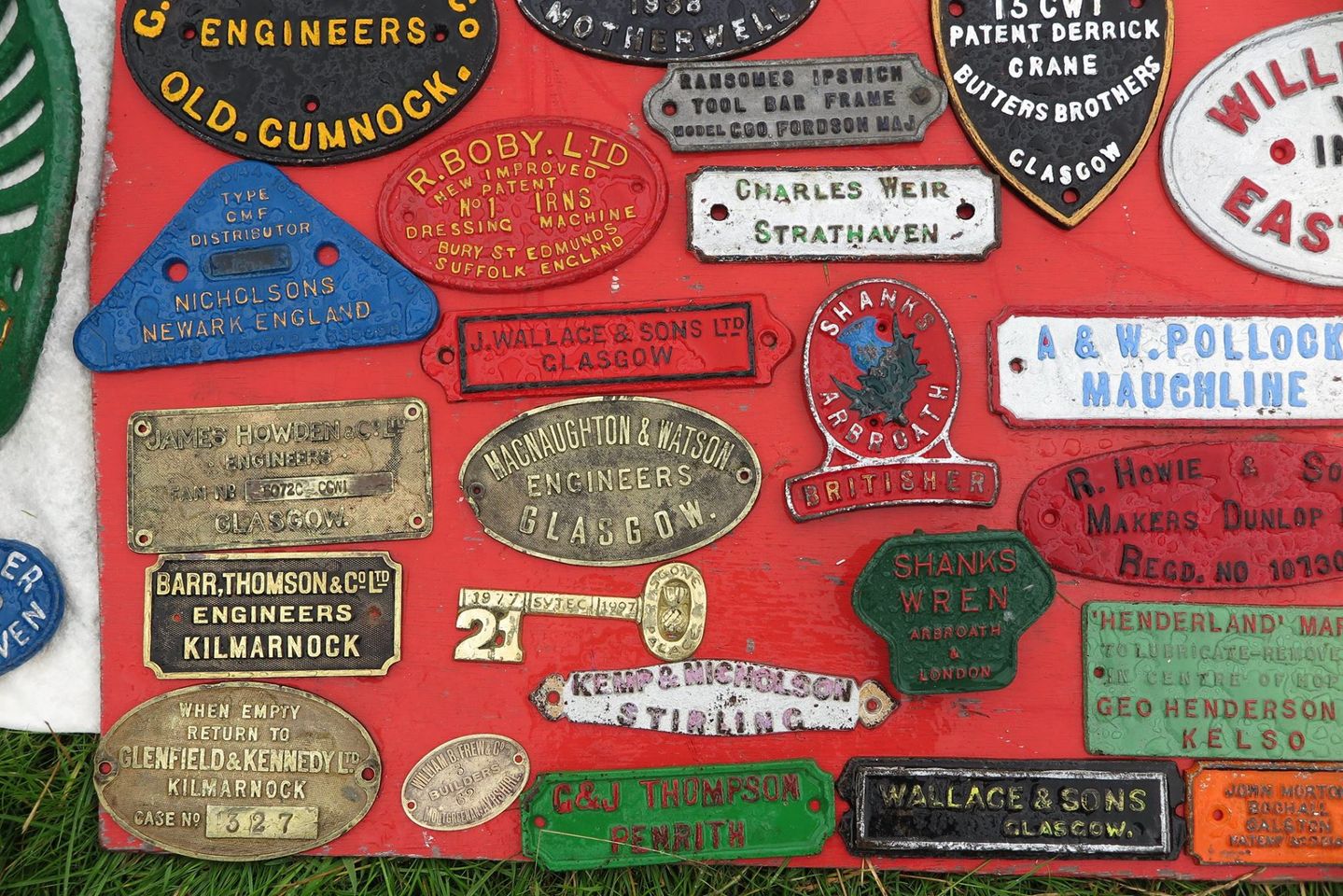
Messrs Kemp & Nicholson, the old-established implement makers, of Scottish Central Works, Stirling, show their “Stirling Castle” self-acting back-delivery reaper, their new “Waverley” reaper and mower, and also their new “North British” reaper and mower, into which steel parts have been introduced in place of iron where strength is required. Amongst their large and varied collection we select for mention their iron sheep fodder rack, which has not been shown at a Highland Show for many years, but which is an invaluable piece of apparatus for flockmasters. The chief novelty, however, on this stand is a cart turnip cutting machine, which is fitted with a revolving slicer for distributing turnips to sheep being fed on grass land. Another very prominent exhibit of this firm’s is a varnished tipping cart of superior finished, with double self-acting lock and elevator.
Messrs Ben Reid & Co., of Aberdeen, have their usual large and important collection. One of the first things to attract attention on this stand is their “Bon Accord” back delivery reaper and rake, which has won for itself a good name all over the north-east of Scotland. Next we observe their patent broadcast sowers, with folding apparatus, and then their patent manure distributor; but the name of “Ben Reid” attached to such implements is sufficient guarantee of their serviceableness, so that further description is needless. Grubbers, pumps, draining rods, garden seats, and hay gatherers are amongst the various specialities of this firm; but a hay baling press, of a new pattern, is a decided novelty.
Messrs Geo. Sellar & Son, Huntly, have, as usual, a very striking collection of ploughs, with long mould boards, adapted for working stiff land. They also show their Anglo-American plough, which is adapted for working on lighter land; while harrows, made of steel, and driven tines, are also a prominent part of this old established firm’s display. It is shown this year with jointed finger bar and a new in-and-out of gear arrangement, for which an additional patent has been applied for. Altogether, this is one of the most efficient and approved harvesters in the market. Chaff cutters, oilcake mills, pulpers, and other food preparing machinery compete this firm’s exhibit.
Messrs jack & Sons, of Maybole, have a prominent stand, which are to be found specimens of their Caledonian “Buckeye” mower and reaper, which we have often described at former meetings of the Highland Society. Messrs Jack are also strong in cultivating implements as well as food-preparing machinery; while their spring carts and vans, as regards quality of material and workmanship, leave little to be desired.
Messrs G. W. Murray & Co., Banff. This old-established Scotch implement firm was represented at stand No. 20. Amongst their numerous exhibits are to be found their “Victory” back delivery reaper, as designed by the late Mr Murray, who was the first to bring out a back delivery reaper of the light pattern; and it must be gratifying to his successors to see other makers adopting the same principle. Messrs Murray show also their hand lever shearing machine, which can cut a bar of iron an inch thick, owing to the powerful way the leavers are arranged.
Mr Robert Kyd, of Coupar Angus, shows his potato diggers and planters, which we have often fully described.
Messrs Newlands & Son, of Linlithgow, show several very useful general purpose and drill ploughs.
Messrs D. Paterson & Sons, Alloa, show a self-acting horse rake and set of wrought iron whipple trees.
Messrs Thomas Sheriff & Co., Dunbar, are a firm we always expect to find in full at a “Highland”. Their display this year will well sustain the credit of this firm for broadcast sowers, for which they are experiencing a very good demand. Amongst these machines, we observe their broadcast sower which took the Highland Society’s premium at Dumfries, about twenty years ago, and also their machine of more recent type, which came out victorious at the Perth trials of 1888. Their fourteen row lever corn drill, with single wheel steerage and land measuring index, is a very useful machine, so that we are not surprised to learn that Messrs Sherriff find that it has become what we may call a “general favourite”.
Mr William Ford, of Fentonbarns, Drem, shows the “Toronto” binder, which, since its introduction several seasons ago, has attained quite an unprecedented popularity amongst the class who require binders. It is the same as last season, except in one of two minor details.
Mr A. Pollock, of Mauchline, showed his improved hay and straw press and trusser, which has a very ingenious transport arrangement; also his new patent rick shifter, which is now largely used in the west of Scotland. No other of Mr Pollock’s exhibits call for special comment.
Mr John Scoular, of Stirling, shows his patent horse rake, with triple active leverage, in nine different sizes.
Mr Alexander Grant, Rothes, shows a steel single plough, and a steel drill plough of approved pattern.
Mr Wm. Davidson, Mintlaw, is again forward at the “Highland” after a few years’ absence. His artificial manure distributor, and natural manure distributor, are first class machines of their kind, and a large number of visitors to the show were highly pleased with an inspection of these machines.
Mr John Doe, of Errol, who acts as an agent for a great number of important implement makers, has a large stand replete with farm implements of all descriptions.
Messrs Flear & Thomson, of Dunfermline, show Wardlaw’s patent turnip thinner, which is the only implement of this description made on the hortizontal principle, and which, we believe, has done excellent work. In a damp season like the present, when the young plants grow so rapidly, a machine like this is a vey valuable acquisition on any farm where there is a large acreage of turnips. On this stand there is also shown a potato dresser, made by Mr Mollison, of Balwearie, Kirkcaldy, which separates the tubers in various sizes by means of a revolving screen with graduated apertures.
Messrs John Wallace & Sons, Graham Square, Glasgow, exhibit at stand 31 a large and interesting collection of reaper and mowers, food preparing machinery, horse rakes, cultivators, &c. Prominent amongst their harvesting implements are their well-known the “City of Glasgow” and “Thistle” reapers, both of which have acquired a wide reputation, and have been largely used for several seasons in both England and Scotland. There also exhibit a combination mower and reaper which is so constructed that it can be either used for back or manual delivery. The famous “Oliver” chilled plough is also seen to great advantage on this stand, the firm having the sole agency in Britain for the sale of this valuable implement.
Messrs John turnbull & Son, Carnock, Larbert, exhibit at the adjoining stand (30) two specimens of the portable hay or straw trusser with which they won the Society’s prize at the Melrose Show last year. This is a most useful implement on all farms, and it is not only light and simple in working, but exceedingly cheap.
Mr David Williamson, Carron Bridge, Thornhill, has brought all the way from Dumfriesshire, and exhibits at stand 32, several samples of his manufactures, such as farm carts, gardeners’ barrows, navvy’s barrow, and a Laide barrow. These useful articles appear to be substantially made, and are admirably finished.
Messrs Alex Wood & sons, Stockwell Street, Glasgow, make a speciality of farm and other weighing machines, several samples of which they exhibit at stand 53. These machines are made in great variety, and are fitted with all the latest improvements. This firm have recently invented and patented a process which completely removes the difficulty that has often been experienced in registering the exact weight of an article, owing to the vibration of the needle of the dial. By a simple process, the needle is made fast the moment the full weight is attained.”
In 1879 the Highland Show was held at Perth. This was a central location, within easy reach of the main populous districts in Scotland, many rural areas as well as to the south and English implement makers. The show attracted many key Scottish agricultural implement makers who brought their award-winning as well as leading implements and machines.
The year 1879 was an important year in Scottish agriculture: it was at the end of a period of continuing growth and increasing mechanism before a long period of agricultural depression that continued into the first decade of the twentieth century.
The Dundee courier of 30 July 1879 provided a detailed account of the implement department of the show. It included some of the key Scottish Makers (with names known well-into the twentieth century) and a wide range of implements and machines. There were a large number of celebrated implements and machines as well as award-winning ones. The article is worth quoting at length for its insights:
“Perth show 1879
Messrs Kemp & Nicholson, also from Stirling, exhibit a capital collection of agricultural implements and machines, comprising their celebrated Waverley, North British, and Caledonian reapers and mowers, horse rakes, hay collectors, farm carts, cart wheels and axles, two and three-wheeled grubbers, harrows, rollers, &c.
Specialities in turnip lifters on a greatly improved pattern are shown at Stand 89 by Messrs Auchinachie & Simpson, Keith, who have been awarded gold medals for these lifters. These gentlemen also show fine specimens of ploughs and grubbers.
Messrs J D Allan & Son, Dunkeld, exhibit at Stand 87 potato diggers, with improved spring lever lifter, and also improved reapers and ploughs and other implements, all of which are of a highly superior description.
A specimen of an American plough is to be found at Stand 135, which belongs to Mr Thomas Scott, Denny. The principal feature of this plough is that it is about a third lighter in draught than ordinary ploughs, while it is fitted with a sock which will serve a season without requiring repair. Mr Scott also exhibits a patent washing machine and an improved wringer, both of which are worthy the attention of heads of families, a wood reaping machine, and a number of other implements.
Messrs J. Bissett & Sons, Blairgowrie, exhibit, at Stalls 156 and 165, agricultural implements of every description and of the best class. Among the principal articles are the turnip lifter and a Scotia mower, fed with two speeds of knife instantaneously, and changeable improved gearing encased and apart from ground wheels.
Mr W. Macfarmane, Ardler, who occupies Stands 160 and 169, shows a great variety of agricultural implements, amongst which are reapers, horse rakes, and drill harrows. He also exhibits a new and improved threshing machine of English style, invented and made by himself, and which is a compact and handy machine for fixed or barn use. The machinery is all enclosed, so that the dust cannot get in, and farmers will find this thresher of a very suitable description. A vertical engine of 6 horse power for driving the machine is also on view, the engine and boiler being on the same base.
Mr R. G. Morton, Errol, exhibits an entirely new direct-acting, high speed threshing and dressing machine at Stand 186. This machine is suitable for either water or steam power. There are only three belts in connection with the machine, and these communicate the power direct from the engine. The machine, to which dust cannot enter, is fitted with Mr Morton’s patent lubricators, which can contain oil to serve for three days. Mr Morton also exhibits grist mills for grinding barley, Indian corn, &c. Wood’s reaper and binder, horticultural engine (fitted with patent lubricators); patent reaper, with Williamson’s back delivery, this reaper being a mower manual and self-deliverer combined, and being fitted with hinged finger-bar and double driving-wheels. The machine was commended at the Royal Northern Agricultural Show at Aberdeen.
At Stand 130 Robert Mitchell & Son, Peterhead, have a number of agricultural machines, amongst which we specially notice a couple of broadcast sowing machines for grain and grass seeds. The peculiarity of these is that the seed box is made in two divisions, and so constructed that each “swirls” round on a centre pivot at each side. The shortness of the half boxes keeps the fore end always at a distance from the horse’s head, and the whole thing is very portable and easily wrought, or stored when not in use. The boxes are of two lengths-18 and 14, the latter being specially suited for small holdings. Altogether, these sowers are likely to make their way with the farming fraternity. A number of rakes, grubbers, rollers, and ploughs at the same stand will repay inspection.
At Stand 139, George Sellar & Son, Huntly, exhibit a number of choice diggers, ploughs, harrows. Barclay & Sellar’s patent digger is now much used by the leading agriculturists in the north. It pulverises the lower part of the furrow slice, and turns over only the upper portion, leaving the roots of the weeds exposed to the winter’s frost, and the ground in a very friable condition. Stubble land cultivated by the digger does not require to be reploughed as it would do after the plough, but only requires to be harrowed in spring, and turnip land is left ready for the reception of the seed. Five of the ploughs at this stand are fitted with mould boards of an improved type, which were thoroughly tested last winter, and have proved very successful. The harrows are not fitted with bolts as usual, but have the tines driven firmly into the slots, thus forming a strong, simple, and durable article. The advantage of this style of harrow is that there is no danger of them shaking loose, and a farm servant can remove the tines when they require repair, and replace them again, without having to take down the whole harrow.
At Stand 147, Messrs Thomson & Co., Kinning Park, Glasgow, have a large number of weighing machines, suitable for use in various pursuits. Among others are machines for hutch weighing and other purposes at collieries, for iron merchants, founders, landing stages, stores &c. A very interesting machine is one of the patent lever construction, awarded the first prize at Compeigne ten years ago, capable of weighing an ounce to 100 tons. This variety are only themselves about half the weight of the hydrostatic weighing machine, and the eight weights of compound lever, an article made to scale five tons, have only a weight of 36lbs. Those with tube cutters and expanders and emery grinding machines ought to commend them for adoption by those concerned, as all are of proved utility in their own way.
At Stand 158 (John D. Doe’s), Adamson & Co. of Dundee and Errol exhibit a very fine selection of agricultural drain tiles from 1 ½ inches to 14 inches in diameter, and also roofing tile, pressed brick, cut, and hardware. These are all being extensively used by agriculturists, and are entitled to practical patronage from farmers and others in want of such material, alike from their clean make and finished, yet substantial workmanship.”
The Highland Show (now the Royal Highland Show) has always been an important forum for the exhibition of the latest agricultural implements and machines. It enabled makers to show their manufactures, for farmers and other agriculturists to be able to compare what was available from other makers, and for the Highland and Agricultural Society of Scotland to recognise the most important innovations and developments, providing with them with awards.
In 1865 the Show was located at Inverness, one of the eight show districts. This was the centre that was of particular interest to those in the north of Scotland. Because of its distance from the more populous districts (and England for the attendance of English exhibitors), there tended to be a larger number of more local implement and machine makers from the area. However, this did not mean that there were not prominent makers from other parts of Scotland. The implement yard could therefore provide some interesting insights into the demand and supply of agricultural implements. This included the different types of them that were brought to the show and the makers who considered this geographical area as being important to their businesses.
The North British Agriculturist, the national Scottish agricultural newspaper from the mid nineteenth century onwards, provided a lengthy account of the show which is worth quoting at length for the insights that it provides. Although the show was over 150 years ago, some of the names of exhibitors were still well-known well into the twentieth century:
“Highland Show
Implement department
The implement department is not imposing, there being none of the complicated and more expensive machines which are so attractive to the ordinary visitor. There is no machinery in motion. The articles are arranged in rows, part being displayed under wooden sheds, and part without any protection. The more eminent English makers are not patronising the present exhibition of the Highland Society. Doubtless the distance from the seat of their manufacturers, and the number of orders which still remain unexecuted, are the causes which have influenced implement makers in withholding contributions to the present show. There are, however, in several of the stands implement and machines from English manufacturers. It does not argue well for the estimation in which the farming of the north of Scotland is held that there is only one portable steam-engine in the yard, exhibited by Williamson Brothers, Canal Iron Works, Kendal, who also exhibit a combined thrashing machine, a turbine water wheel, and a centrifugal pump. The implements which are shown in the greatest numbers are ploughs, harrows, and reaping machines. Mr Allan, Culthill, Dunkeld, shows several well constructed ploughs and horse shows, with two turnip sowing machines. Mr Barber, Leicester Buildings, Liverpool, exhibits the “Eagle” mower. Mr Bradford, Manchester, an extensive collection of washing-machines and other articles for the laundry. Messrs Brigham & Bickerton, Berwick, exhibit several of their well-known excellent reaping-machines. Messrs Jack & Son, Maybole, show a Hussey’s reaper, a Buckeye combined reaper and mower, and other articles. Messrs Law, Duncan & Co., Shettleston, have a potato-digger, a patent reaping-machine, a subsoil plough, &c. Sir John P. Ord of Kilmory, Bart, shows a horse collar made of bent grass, and matting of the same material-both very cheap and good. Mr Rawdin, Jedburgh, exhibits dipping tubs for dressing sheep. Mr John Richardson shows specimens of his well-known fanners. Riches & Watts, Norwich, an American grist and corn-grinding mill. Messrs Richmond & Chandler, Manchester, have an excellent assortment of chaff-cutters and other food-preparing machines, which are now, we are glad to say, being better understood and appreciated by farmers in Scotland. Mr Ross, Cullen, shows a very good plough and turnip-sowing machine. The Singer Manufacturing Co., Dundee, exhibit several sewing machines. Mr W. Kennedy, 182 Princes Street, Edinburgh, shows a splendid collection of these useful and popular articles.
Messrs J. & T. Young. Vulcan Foundry, Ayr, exhibit good combined reaping and owing machines; one, being adapted for one horse, is said to have proved a very great success. The same firm has also several other articles useful in the farm and the dairy. Messrs Kemp, Murray, & Nicholson have an extensive collection of food-preparing machines, reapers, horse-rakes, rollers, grubbers, harrows, garden seeds, &c. Messrs Morton of Liverpool have a varied and extensive collection of galvanised iron and wire fencing, along with models of buildings in corrugated iron. Messrs Picksley, Sims, & Co., Leigh, show an unusually large collection of food-preparing machines, troughs, bone-mills, rakes, reaping machines, lawn mowers, garden seats, &c; along with an excellent collection of superior American cast steel hay and manure forks.
Mr John Pringle, Berwick, Kelso, and Edinburgh, has a very extensive and well-assorted collection of implements, consists of several patent reaping and mowing machines, food-preparing machines, harrows of various forms, a number of corn-screws, wire netting, sheep troughs &c. Messrs Benjamin Reid & Co., Aberdeen, exhibit their 4-inch row drilling machines, a number of food-preparing machines, Howard’s ploughs and rakes, Cambridge’s clod crushers, Shank’s mowing machines, Jebb’s patent tubular churn (a new invention which is attracting a considerable amount of attention from the short time in which butter is produced), &c.
Messrs Davie, Brown, & Young, Stirling, exhibited reaping machines, a land roller, and a turnip slicer. Mr Forbes, Inverness, shows reapers, turnip cutters, and corn crushers. Mr Finlayson, Arbroath, exhibits a large self delivery reaper, which is stated to be of radical improvement. Captain Fraser of Balnain, shows a cumbrous looking machine for making peats, a primitive plough for clearing snow off hill pastures, and a still more primitive looking harrow for the same purpose. Messrs Hudspith & Co., Motherwell, show pipes and collars, bricks, &c. Mr Hunter, Maybole, displays a new turnip cleaner, ploughs, grubbers, harrows, &c. Mr Kirkwood, Tranent, has an ordinary two-horse plough, the Tweedale ploughs, grubbers, harrows, &c. Mr William Kirkwood, Duddingston Mills, Edinburgh, exhibits a new two-horse grubber, a potato lifter, a Norwegian harrow, horse rakes, &c. Messrs McGregory & Humphreys, Aberdeen, exhibit their well-known ploughs, besides horse rakes, harrows &c. Messrs Main, Kempt & Co., Glasgow, have an extensive collection of rick stands, fencing, hurdles, field gates, sheep netting, field gates, chairs &c. Messrs Middleton & Co., Edinburgh, exhibit their wire fencing with pillars and stays, garden stats, galvanised wire netting, hurdles &c. Mr Mitchell, Peterhead, has in his stand a one-horse cart, drill sowing machines, harrows, and rollers. Mr Robson, Glasgow, exhibits a number of articles made of fireclay, such as cattle troughs, wall coping, ridging, sewage pipes, &c. Messrs Sellar & Son, Huntly, have a large assortment of ploughs and harrows.
Mr Wilson, Loanhead Works, Dunfermline, shows a number of excellent troughs and other articles made of fire clay. Mr Wingate, Alloa, exhibited his iron meat coolers, corn bins, and other articles. Messrs W. D. Young & Co., George Street, Edinburgh, have wrought iron gates, hurdles, fencing, garden seats, chairs, and a large number of articles made of galvanised iron.”
It is always interesting to read accounts of how the implement trade has fared, especially during difficult economic times. The First World War – 1914-18 – was a challenging time for Scottish farmers for a whole host of reasons. The Daily record published an account of the agricultural implement trade on 2 January 1917. It notes the challenges (including competition from overseas countries) and successes of the trade during the year. It is worth quoting at length:
“Agricultural implements
The agricultural implement branch of the engineering trade report a favourable year’s business as to volume, but all are not agreed that it has been profitable. The prices are to some extent regulated by the severe competition in certain lines from the United States, and we have to thank the high freights of the past year, which have given the home makers a more equal chance.
Spring implements sold out as fast as they could be made. The hay crop, which was a bulky one, coupled with the long-drawn-out operation of gathering it, consequent on. unfavourable weather, made a good demand on the makers of mowers, rakes and hay-makers. Perhaps the call for grain harvesting machinery did not reach expectations, but here again the unfavourable weather affected sales, this time adversely.
It is strange, but true, that 1916 will be remembered as the year when early districts were late, and vice-versa. Potato digger sales probably reached a record for the home trade, notwithstanding the shortage of the crop, but in this case the high prices prevailing for potatoes induced many to purchase who would not ordinarily have done so. Another cause for the increased demand was the lateness of the season, which, with the small amount of labour available, made it necessary to use mechanical means of saving the crop.
In our last report we made reference to the use of mechanical tractors for field use, but although a year has elapsed we cannot say that a great deal of progress has been made. Sales there have been, principally in the southern portion of England, but the disadvantages of the present types in use have been in consequence coming to the surface as well as the advantages. In all likelihood we shall see in a few years a type of tractor more reasonable in weight, adapted not alone for crops grown on the flat, but probably also designed to permit of working green crops, where these are usually grown in ridges or drills. Then in a sense it is vexing to know that huge orders may be had for countries such as Russia and other Allies, but that home makers, because of the difficulty of getting raw material and labour, are simply compelled to turn them down.”
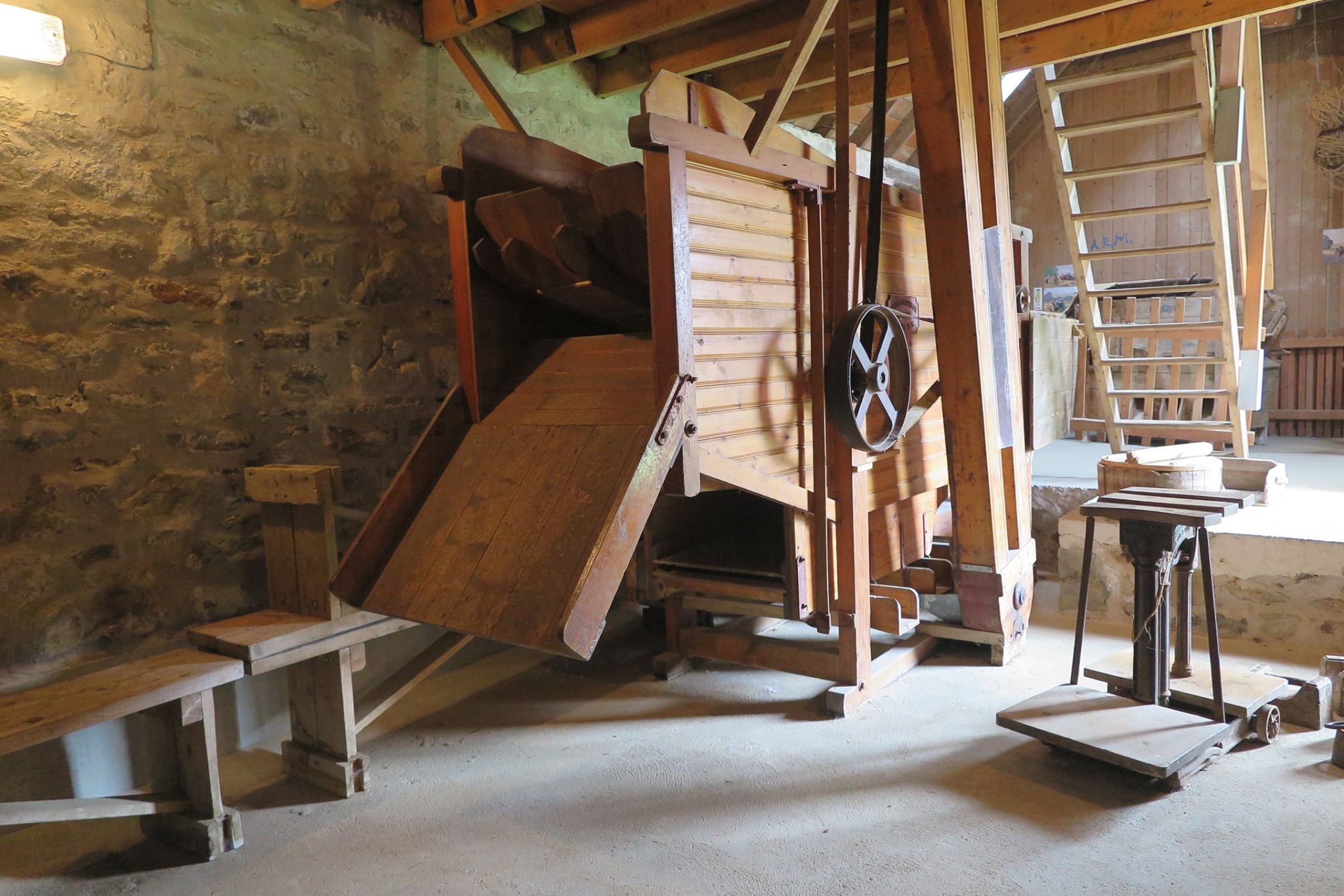
On 27 January 1902 William Wright, millwright and joiner, Boyne Mills, near Portsoy, Banffshire, passed away. He was 60 years of age. In his lifetime he had established and run a successful millwright business which was well-known throughout the district. He was also the carpenter for the Hay Memorial, Cornhill.
The Aberdeen press and journal of 29 January 1902 carried an obituary. It wrote:
“The late Mr William Wright, Boyne Mills
There are many in the north who will see with regret the announcement of the death of Mr William Wright, Boyne Mills, Boyndie, for Mr wright was well known and was held in high esteem over a large area. He had reached the age of sixty years, and had been in delicate health for about a year. Mr Wright (says the “Banffshire Journal”) was born in Alehouseburn, Ord, where his father resided. He learned the trade of a millwright, and at 23 years of age began the construction of mills on his own account. His business soon became very successful. For 12 years he carried on his business at Alehouseburn; for rather over 12 years he was at QuarryCroft, Ord, and for the past 12 ½ years he had been at Boyne Mills. At the Boyne he was also engaged in the more general business of a joiner. Mr wright, who passed away yesterday, is survived by his widow and a family of eight.”
There are some adverts which reveal the mills that he manufactured. They included ones with bucket wheels, 8 feet diameter, another with a bucket wheel of 9 feet 4 inches in diameter, gearing for a 4 horse mill, light horse mills with peg drum, crank shaker and fan, large spur wheels and bevel wheels for horse mills.
Alongside his mills he also sold other implements. In 1892 they included manure distributors for sowing pulverised manure and in 1901 Tangyes oil engines. He noted that “these engines have now proved themselves to be the best in the market, for they are easily managed band give more working power than the makers give them out for. They are very finely finished and well fitted in every way, and the consumpt of oil is very small for the power given off. Any ordinary labourer can work them after seeing them started. For driving threshing machinery there is nothing works better for steady running; the speed continues the same, although the mill is running empty. I have had to do with a number of engines from different makers, but I find that the Tangyes engines give the best satisfaction.”
Shortly after his death his business at the Boyne Mills was put up for public sale. It provides insights into the businesses and the tools and machines he used to make his mills and other manufactures:
“Displenishing sale (from Banffshire reporter, 23 April 1902)
Boyne Mills, near Portsoy, Banffshire
There will be exposed for sale, by Public Roup, at Boyne Mills, on Saturday, 3rd May, 1902, the following subjects belonging to the Executrix of the late William Wright, millwright, carpenter, and general blacksmith, viz:-
Millwright plant:-1 new high speed threshing mill, 1 do, partly constructed, 1 large circular saw and bench, small do., moulding machines, 2 turning lathes, boring machine, wheel, checking and morticing machines, brass and metal fittings, shafting, pulleys, pinions, belting.
Carpenter’s stock-4 double benches and pertinents, tools, paints, oils, nails, bolts, large quantity of seasoned timber of good quality, comprising battens, linings, framing, moulding, boards, patterns, one pair spring cart wheels, two pairs gig shafts, large wood sheds and stores with corrugated iron roofs.
In the early 1900s a number of local newspapers throughout Scotland reported the erection of new threshing mills on farms as farmers updated their machinery or moved from using the travelling threshing mill to their own ones.
The erection of this plant was a significant occasion. It marked the introduction of new technology, a substantial investment into the farm and its activities as well as a change in the management of the processing of the grain crop.
Farms often marked this occasion with a social event in which neighbours and others were invited to partake in food and drink, and a congenial evening of activities. They also got to see the new mill at work. The feeding of the first sheaf into the mill was at some farms seen to be a special event, sometimes being given to a key member on the farm; it could be a long-standing farm servant or a past tenant.
The accounts in the newspapers provide varying amounts of information about the new mills. Sometimes they record the names of the maker of the mill and the mode of power for the mill (water, engine or tractor).
The following are short accounts from newspapers that record the introduction of new threshing mills onto farms in Banffshire:
“Introduction of new threshing machinery (from Banffshire reporter, 29 October 1902)
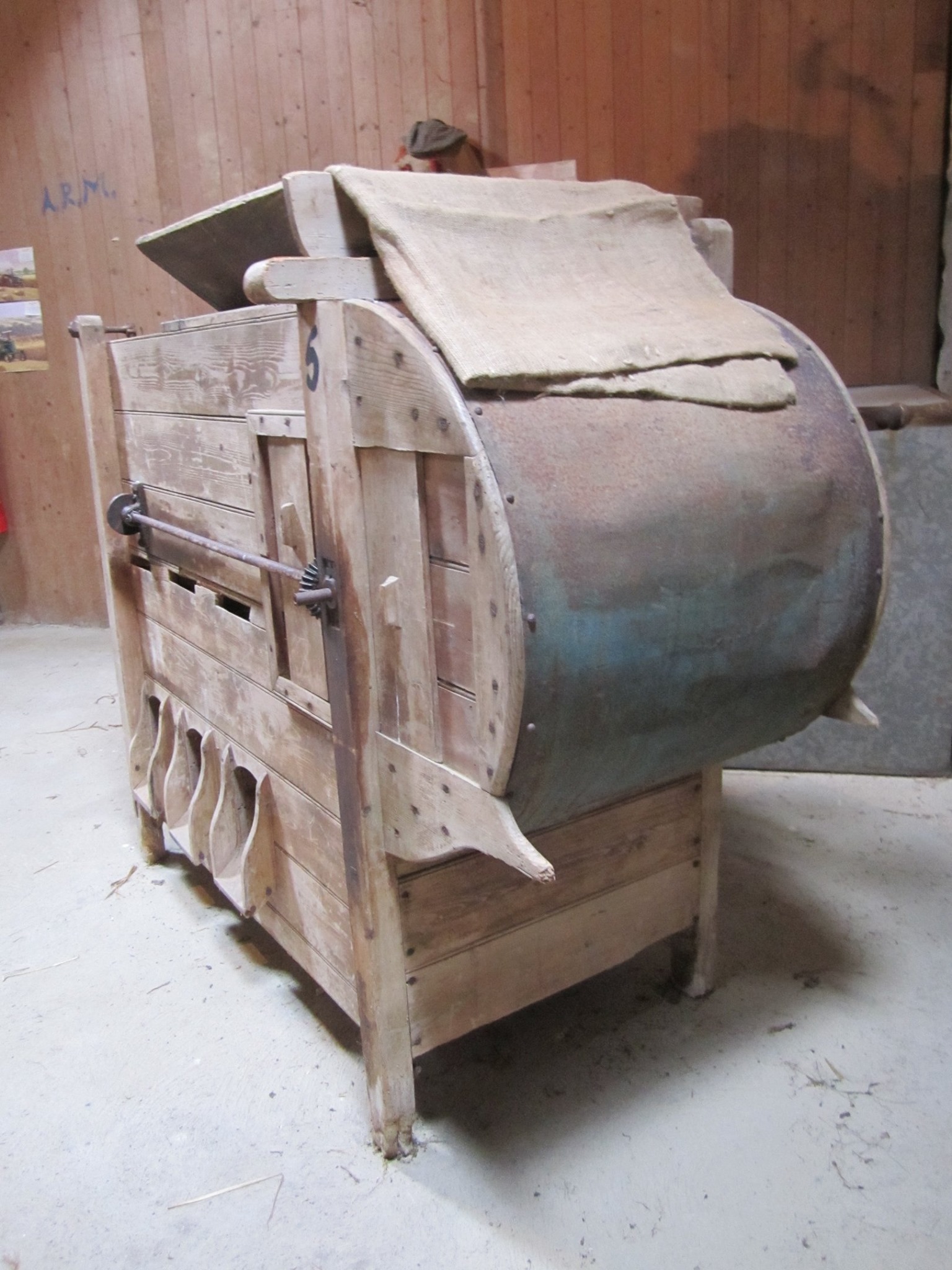
Farmers in the Hilton district are realising the importance of having up-to-date threshing machinery. Last week new mills were “set on” by Mr Watt, Blairmaud, and his neighbour, Mr Andrew Lyon, Alehouseburn. Messrs Macdonald, Bros, Portsoy, were the contractors for the Blairmaud mill, and Messrs Wright, Boyne Mill, for that of Alehouseburn. Both mills are on the high speed principle, with dressing, elevating, and chaff blast appliances, and reflect the highest credit on the firms named, alike for their design, quality of workmanship, and their equipment with the best of up-to-date modern appliances. Both mills are driven by ten feet overshot wheels. At the “on put” of the Blairmaud, mill in spite of the rank, coarse, and not over dry straw, the thresh was about eight quarters per hour.”
“Trial of a new mill (from Banffshire reporter, 25 March 1903)
A short time ago arrangements for a renewal of the lease of the farm of South Sandlaw, Alvah, were completed between Mr Greig and his landlord, and this news was hailed with pleasure by Mr Greig’s many friends and neighbours in the parish of Alvah. Mr Greig belongs to the progressive class of agriculturists, being ever ready to adopt new and improved implements and methods of husbandry, when he sees that their introduction is likely to be attended with economy of labour on the one hand and an increase of yield on the other. On Wednesday afternoon a representative gathering of farmers met at Sandlaw to witness the latest outcome of Mr Greig’s enlightened policy, to wit, the trial of a new and up-to-date threshing mill. The mill is a 3ft 6 in one, and is fitted with a high speed drum and eccentric shakers embodying an improvement by the millwrights on the ordinary shakers of this pattern. By a special arrangement of the draught the winnowing is done to satisfaction by one fan, instead of by two or three as in most mills. The mill is also provided with a. rotary adjustable screen. The grain is delivered ready for the market in a loft above by means of elevators, while by another labour-saving device the straw is conveyed past the middle of the “straw end” of the house. The chaff finds its way to a shed about 80 feet from the mill by means of a “chaff blast”. Here again the ingenuity of the millwrights has improved on devices of this sort for the removal of the chaff. The motive power for all this machinery is supplied by an oil engine (Tangyes) of 10 horse power, but capable of working up to 11 ½ horse power. At the trial on Wednesday the mill gave entire satisfaction, all the visitors being loud in its praise. It may be mentioned that a 45 minutes’ “thresh” gave over 10 qrs. Messrs Wright Brothers, Boyne Mills, Portsoy, were the millwrights.”
“Deskford (from Banffshire reporter, 11 January 1905)
Last week Mr Alexander Jamieson, Mains of Skeith, had been fitted up at his farm a fine new threshing mill, by Messrs Wright Bros, Boyne Mills. The mill is driven from a 12 feet by 4 feet bucket wheel. At the start the mill threshed over 8 qrs per hors, carried the oats up to a high loft, and, having a chaff blast, the chaff can be sent to any part of the farm buildings by a spouting. Messrs Wright deserve great praise for their fine workmanship, seeing it is only a month since Mr Jamieson gave them instructions to proceed with the work, A few friends were present to witness the start. A pleasant hour was spent afterwards, when the health if the millwrights was pledged.”
“Deskford (from Banffshire reporter, 21 November 1906)
On Saturday Mr Brodie Taylor, Swailend, invited a few friends to witness the start of a fine new threshing mill which has been fitted up at his farm by Messrs Wright Bros, millwrights, Boyne Mills, Portsoy. The threshing mill is quite a small one, having only a 30-inch high-speed drum, and about 10 feet shakers, which are neatly fitted in with a 4-inch crank shaft. The grain is conveyed by elevators to the loft above, and all this, with a fan and barley beater, is driven up to the required speed by a 12-feet underwater wheel, which seems quite fit to drive the machinery. The grain selected for the thresh was oats which had been a very heavy crop, and these the mill drew in at a great rate and finished very satisfactory. Messrs Wright were highly complimented on the finish they had put in such a neat threshing machine.”
“Installation of threshing plant at Durn Mains (from Banffshire reporter, 27 March 1907)
A pleasant gathering tool place at Durn Mains, Portsoy, on Thursday, when a number of neighbouring farmers and others attended to see the start of the new threshing plant which has been introduced by Mr D. O. Stevenson, who at Whitsunday last entered into the tenancy of this fine farm. Formerly there was a steam engine and threshing mill, but these have now been cleared out and an oil engine and new threshing mill introduced, besides various alterations made, which tend to the more convenient working of the arrangement of the steading. The motive power of the new threshing plant is an Allan oil engine. It is of fourteen horse-power, and is of the latest type, with balance discs on the crank shaft, and is at once easy of management, smooth running, substantial in workmanship, and of a pretty model. The mill is driven by a shaft which is introduced through a hole in the east wall of the engine-house, alongside which is the mill and sheaf-barn, a long commodious apartment. At one end is the sheaf-barn, capable of holding a couple of large stacks at a time, and reached from the outside by a large double door capable of introducing loaded carts. The floor has been all laid with concrete, and everything is arranged in a most convenient manner. The mill has been erected by Messrs Wright Bros, Boyne Mills, and is of the three feet six inch full-finishing type, with Pennie’s patent adjustable rotary screen for sizing the grain. It is capable of threshing about ten quarters an hour.”
“Farm improvements in Portsoy District (from Banffshire reporter, 20 November 1907)
On his entering of Hillside, Portsoy, a short time ago, Mr James Murray, V.S., Cullen, set about making many improvements on the steading and on the land. On Saturday, on Mt Murray’s invitation, the neighbouring farmers and some friends from a distance assembled at Hillside to see the maiden efforts of a new new threshing mill. After the first sheaves had been deftly shaken in by ladies, all the guests in turn “fed”, and examined the working of the various parts of the machinery of the mill, and the skilful arrangements for the conveyance of power by rope from the water wheel. After the threshing was finished, the power was simply and quietly transferred to a bruiser and kibbler fitted in the loft near the hear of grain brought up by the elevators. Everything went smoothly and successfully, and it must have been very gratifying to Mr Murray to see the successful issue of all his plans. When the inspection was over the party adjourned to the house and sat down to refreshments prepared by Mrs Brown. An interesting discussion took place on the use of such a mill for the farmer, and it was agreed that the workmanship of the mill at Hillside reflects great credit on Mr Wright, Boyne, who carried out the contract. A very pleasant evening was spent.”
(from Banffshire reporter, 25 March 1908)
“Mr Peter Gaul, farmer, Whiterashes, Turriff, has just got fitted up at his farm a thoroughly modern and up-to-date threshing mill and Allan engine, the work of Mr Wright, Boyne Mills, Portsoy. On Thursday Mr and Mrs Gaul invited a number of their friends and neighbours to spend the afternoon and witness the “on-putting” of the new mill. The expeditious and satisfactory manner in which the mill performed its work was the admiration of all, and reflected the highest credit upon the millwright.”
Displenishing sales provide an insight into the implements and machines that were being used on a farm when the tenant was leaving a particular farm. They reflected the type of activities that were being undertaken, including chicken rearing, potato growing, or cheese making. They can also show whether the farm was using new and innovative ones or were relying on older ones. Some of the items that are listed were old, though others, as notices sometimes point out were new. They would also have included implements that might have been allocated to the “hedge back” that were put out for sale to realize some money.
By the mid 1940s farm mechanisation was making in-roads on Scottish farms. There was an emphasis on tractor power and using a wide-range of implements and machines for crop and animal husbandry, though horse power and horse-drawn implements still continued to be used. Some farms invested in tractors with their associated name-sake implements and machines.
The following displenishing sale notices for farms in eastern and north-eastern Scotland show the level of mechanisation on these farms, the different types of implements and machines as well as in some cases their makers – who tended to be leading and well-known ones.
Pitgarvie, Laurencekirk (from Mearns leader, 2 November 1945)
“Tractor and tractor implements
Fordson tractor, 1939, on rubbers (high geared), Fordson tractor, 1942, on rubbers, Fordson tractor, 1942, on irons (high geared), 2 International, 2 furrow tractor ploughs, 1 high clearance International corn drill, 20 discs (new), Scott tool bar (new), tractor roller, 6 barrels (new), 12ft lone waggon (new), with frame, 2 tipping bogies and frames (new).
Horse implements etc
6 box carts (2 new) (5 on rubbers), 4 lying carts, McCormick binder, 6ft cut, 2 McCormick binders, 5ft cut, Albion mower, Bamfords mower, 2 horse rakes, 2 stone rollers, 3 brake iron harrows, broadcast (Ben Reid) potato coverer, Mollison digger, 2 potato grubbers, cultivator, 3 drill ploughs, 3 swing ploughs, 2 scrapers, grubber, manure distributor (Reid & Leys), turnip sower, disc scarifier, snow plough, sledge, car trailer, single roller, chain harrows, yokes and swingletrees, 2 binder covers, 4 sack covers, 2 turnip hashers, grindstone, potato harp, boxes and riddles, binder twine, stack bosses, stack props, 4 henhouses, 200 gallon tank, 100 gallon tank, and 50 gallon tank, long marker, hay paddock, long ladder 32ft, 3 small ladders, posts, wire, strainers, 6 tons slag, 200 drain pipes (new), mash barrow, 3 turnip barrows, water barrel, sack lifter, sack barrow, steelyard and weights, garden plough, trestles, power horse clippers, fostermother, fire extinguishers, pig troughs, forks, graips, scythes, 14hp Vauxhall motor car, harness for 3 pair horses, dairy utensils and the usual minor hand tools.
Note – all the above implements are in perfect order and worthy of attention.”
Mains of Lauriston, St Cyrus (From Aberdeen press and journal, 3 November 1945)
“Tractor implements
1 Fordson tractor on rubbers, 1 Fordson tractor (iron wheels), 1 6-foot Bisset binder, 1 B.D.F (D.B.) plough, 1 Seller (D.F.) plough, Newlands ridger, 1 bogey, 1 rubber-tyred art fitted for tractor, S.F. Oliver plough, hay sweep etc.
Horse implements
2 box carts, long cart, Mollison potato digger, McCormick mower, Massey-Harris binder, turnip sowing machine, broadcast, drill sowing machine, 2 scrapers, potato dresser, harrows, S.T. harrows, 1 110a plough, 2 D.B. ploughs, potato planter, steelyard and weights, sack barrow, ladders, 3 barrows, scarifier, paraffin drums, 2 horse rakes, turnip slicer, spraying machine, 50 potato boxes, and large assortment of minor implements. 3 hen houses, 3 stacks hay, Lucas electric firelight set (complete), dairy utensils.”
Craigmosten, Fettercairn (From Aberdeen press and journal, 3 November 1945)
“Implements
Fordson tractor, extending axle for same, tractor wagon, 4 wheeled lorry for tractor, 3 box carts (2 on rubbers), turnip cutting carts, long cart, Massey-Harris binder, 2 Bisset binders, Hoosier drilling machine, Bisset mower, manure distributor, Sellar broadcast sowing machine, 3 Sellar ploughs, 110 ploughs, improved 110, 2 D.B. ploughs, 3 drill harrows, 3 brake iron harrows, 3 sets S.T. harrows, grubber, Bisset potato planter, Bamford potato digger, circular saw with travelling bench, batteries for Wolsey fencer, scarifier, turnip sower, 2 horse rakes, iron rollers, stone rollers, Martin tractor cultivator with ploughs, tractor yoke corn mixer, cattle float, 2 steelyards, cake crusher, turnip cutter, hay gatherer, 3 grindstones, yokes and swingletrees, graips, shovels, hoes, harness for 3 horses, 3 barrows, land marker, potato boxes, lanterns, dairy utensils, Alfa-Laval separator, barrel churn, butter tub, large meal girnal, bothy furnishings, 2 paraffin drums (100 gal), 3 henhouses, Thornby incubator (100 egg), poultry appliances, boilers, ladders, 4 hives, bees, and the usual minor hand tools.
Note-all implements are in good order and have recently been overhauled.”
Bellfield, Inverbervie (From Aberdeen press and journal, 3 November 1945)
“Tractor and tractor implements
Fordson tractor on spade lugs, Ransome sock-bar 2-furrow plough (almost new), Sellar sock-bar 2-furrow plough, Newlands tool bar with ridger and cultivator (new), disc cultivator, rollers (horse or tractor), 2 tractor bogeys (1 screw tipper), tractor cart, pair spade lugs with wheels.
Horse implements
McCormick binder, Bisset binder, Bamford mower, International manure distributor, 2 horse rakes, potato planter, 3 brake iron harrows, S.T. harrows, chain harrows, circular harrows, drill harrow, broadcast grubber, drill sowing machine, 2 drill ploughs, 2 110 ploughs, S.B. and D.B. ploughs, turnip sowing machine, 2 turnip cutters, cultivator, 2 steelyard and weights, hay paddock, potato pulper, Cooch potato dresser, cake breaker, liquid manure pump, scarifier, meal girnal, 3 cattle troughs, sheep troughs, pig troughs, 4 portable hen houses, stack bosses, grindstones, smithy bellows, anvil, vice and tools, 2 joiners’ benches, screw vices, dry pig feeder, patent sack lifter, 6 doz potato boxes, posts and wire, sheep wire netting, rope spinning machine, bindles, barn fan, bushel and straik, forks, graips, shovels, picks, mell, long marker, rabbit hutch, oil drums, harness for 3 horses, tilley and other lanterns, dairy utensils, including Hathaway churn, 100-egg Tamlin incubator, Glevum hover, number of poultry, and the usual minor hand tools, etc.”
Craighead of Benholm, Johnshaven (From Aberdeen press and journal, 10 November 1945)
“Tractor implements
Fordson tractor on rubbers, tractor bogey, Ransome mid trac D.F. plough, Ransome disc harrows, S.T. harrow, tractor harrows, Scott ridger and tool bar (almost new), Dunlop straiks for Fordson.
Horse implements etc
2 box carts with tops (on rubbers), 2 M.F. Sellar ploughs, 110a plough, 4 brake iron harrows, chain harrows, drill harrow, potato grubber, double metal roller, Sellar broadcast (new), manure distributor, turnip sowing machine, Bamford hay mower, Bamford horse rake, hay Jack, Hoosier cultivator with furrowing-up attachments, grain sizer and mixer, barn fan, steelyard and weights, sack barrow, extending ladder, long marker, plough hurley, turnip slicer, stack cover, stack bosses and props, potato hopper, potato boxes, potato riddles, grain and manure sacks, esparto rope, cart ropes, fencing tools, plain and barb wire, yokes and swingletrees, graips, forks, shovels, hoes, scythes, portable henhouse, lanterns, power horse clippers, cart and plough harness for 2 harness, cattle bindings, water bath, oil cabinet, corn chest, dairy utensils, and the usual minor hand tools.”
There have been numerous developments in potato planters since the latter part of the nineteenth century. Inventors and makers included farmers, blacksmiths, implement makers and their businesses; some makers took on designs that they considered would be successful.
One farmer who was also an inventor was Thomas Pate, jun, of Emmock Farm, Dundee. In 1934 he was awarded a patent for a mechanical potato planter. The following account of the planter was described by the Kirriemuir free press and Angus advertiser in its columns of 1 March 1934:
“ Kirriemuir farmer’s son’s invention
Improved potato planter
Full patent rights granted
Full patent rights for an improved potato planter have been granted to its inventor-Mr Thomas Pate, junior, Emmock, Dundee, son of Mr Thomas Pate, farmer, Reedie, Kirriemuir.
Mr Pate’s invention marks a new stage in mechanical potato planting. It relates to machines for planting potatoes of that type, to quote the official patent specification, in which an endless chain of buckets takes the potatoes from a hopper and tilts them into a delivery tube. Its principal claim to distinction is that it will plant potatoes of different sizes.
By a simple device the “buckets” automatically adjust themselves to the size of the potato, which is carried sweetly to the delivery tube, without fear of clogging, and a regular planting of the seed tubers is provided.
A practical demonstration will likely be arranged in view of the interest that will be aroused. Mr Pate, who is widely recognised as a capable farmer, has farmed Emmock for 20 years, a holding which he purchased in 1920. His father, who is now at Reedie, framed Balydown, Dundee, for 19 years after he migrated from the Lesmahagow district of Lanarkshire.”
Thomas Pate was a very successful farmer. Four years after he developed his potato planter, he extended his farming operations to take on an additional lease. He was involved in supporting agriculture and agricultural policy. In July 1938, the Dundee courier referred to him as a “go ahead farmer”:
“Go ahead farmer
Mr Thomas Pate, jun, Emmock Farm, Dundee, who has just taken a lease of South Powrie, on Fothringham estate, belongs to Lesmahagow, Lanarkshire, although he has lived nearly all his life in the Dundee area.
As a boy he came with his father to Balmydown, which farm adjoins Emmock. He took over Emmock in 1914 and bought it in 1920. Running both Emmock and South Powrie, Mr Pate will now farm some 570 acres.
Since he took up farming on his own account Mr Pate has become one of the leading agriculturists in the county. He became a member of the National Farmers’ Union and Chamber of Agriculture in 1917, and is now in his second year of office as chairman of Dundee branch and president of Angus executive.
Some years ago Mr Pate was co-opted to assist in the agricultural education work promoted by Angus County Council. In this sphere he has done much experimental work. He is also a member of the Angus and West Perthshire Wages Committee, the body recently formed to fix minimum wages for agricultural workers.
Made potato planting easier
A few years ago Mr Pate made an important contribution to the improvement of agricultural machinery. He produced a new type of potato planter, which, by means of an endless chain of buckets, plants potatoes of different sizes.
By a simple device the buckets automatically adjust themselves to the size of the potato.
Apart from farming, Mr Pate’s chief interest is his church work. He has been an elder at Mains and Strathmartine for many years.